
Erick van Egeraat beyond architecture
Erick van Egeraat is a Dutch architect and author. He heads the architectural practice based in Rotterdam with offices in Moscow, Budapest and Prague. He is the winner of RIBA Award 2007, Best Building Award 2011 & 2012 and European Property Award 2013.
Six Ideas About Architecture – Texts by Deyan Sudjic for Erick van Egeraat Associated Architects
22 July 2026WATCH ERICK VAN EGERAAT’S LATEST LECTURE ON SHAREarchitects.com
04 June 2020DIGRESSOR OF NORMS
22 November 2017Erick van Egeraat in dialogue on 100th Catholic Day in Leipzig
30 May 2016Column: Thoughts from an Architect
27 May 2016Column: Value (f)or Money
Column: Life without Beauty
Grigory Revzin: The Street Leading Upwards
16 February 2016De hele wereld loopt sneller dan Nederland
07 December 2015Making affordable housing more attractive
06 November 2015We leven in het Luxe Tijdperk, en daar bouw ik naar
03 September 2015Interview: Russia can do much better, with or without international support
01 August 2015Interview: Waarom architect Erick van Egeraat successvol is in Rusland
29 June 2015Effortless Everywhere
24 June 2015Luxury living concept in Mercury Tower, Moscow
14 June 2015Memories for the Future
01 June 2015Interview: New Impulses
14 April 2015Galvanize the City
07 March 2015Nieuw stadion Feyenoord wordt gegarandeerd een kutgebouw
01 March 2015Interview: Tastes differ
19 February 2015Interview: If you think I’m genius, I wouldn’t mind
14 November 2014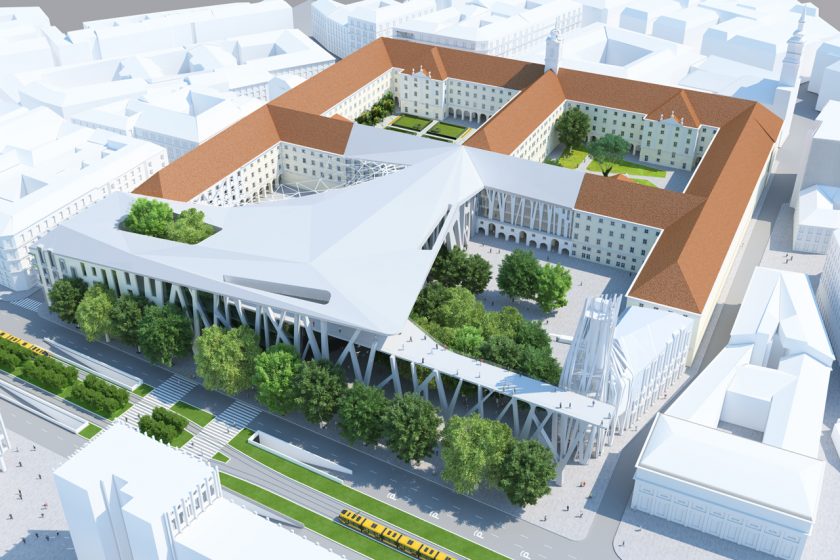
Galvanize the City
Saturday, 7 March 2015A lecture delivered by Erick van Egeraat at the 12th International Convention of Architecture in Budapest.
I came to Hungary about 25 years ago as a guest. And I was very lucky to be allowed to do something in the city. It’s now 25 years later and I still feel a guest here. I don’t own anything here, I don’t have any rights here, I am just happy to be able to do something which hopefully the other people can appreciate. That’s the way we should look at each other. I’m not Hungarian, I am Dutch. I try to do things in a nice way using my life experience and learning from yours. This exchange is essential for the development of all our cultures.
Please take the following thoughts and words in your life. I would like to make some statements about the ideas which are recently emerged about building of the museums in the Liget. I want to share with you my views, these are just personal views, they might be completely wrong, but they are sincere.
In 1994 I came here to work to Budapest on my first project in Andrassy ut. It was a minor intervention and historic renovation. Later we did an extension in the street behind Andrassy ut and we rebuilt, reconstructed the Deak Palace. We also worked on the Liget Center, (former MEMOSZ headquarter) and we designed the ING Headquarter building next door in the following years. My latest work in Budapest was a competition design for a new football stadium, where I tried to capture something simple and new; this entry was unfortunately unsuccessful, maybe too simple, I don’t know.
As for the international projects in the recent five years I was working on Drents Museum in Assen in the north of the Netherlands. An old complex originated in 14th century, its buildings are partly from 17th, partly from 19 century, and we were asked to extend this museum complex even though there was a little space to do something. We decided to build the extension of the museum underground, on the former parking place and create there an extension of the local park.
Another project I am presently working on is the University of Leipzig in Germany, a restoration in the Netherlands, an old building changed into Erasmus University College, the University of Sberbank in Russia, 1-km long complex where people are trained to start working for the bank and not for themselves. We also recently finished the incinerator line in Denmark, Roskilde. It gets rid of waste and at the same time produces energy. I made a new museum proposal in the centre of Moscow, and a recreation of a city center in Saudi Arabia, in the city of Unaizah.
And with this let’s say baggage I am here to speak to you. We have a park. You all know this park. I know this park, because I worked there; I have been creating my own building and creating other building on the edge of the park, because my office was on Dozsa Gyorgy ut for many years. So, if you’re asked to do museums, of course every architect likes doing museums, because of those nice ideas to bring among artistic friends. Yes, of course if you ask me to do a museum, I will not say no. I will say: yes, please. But it doesn’t mean that I will stop thinking. It doesn’t mean that I will say: wow, you know, let’s do a museum, because it’s the first moment I don’t need to again endlessly argue about money and costs and deadlines and prices etc. Because now I am with the good guys, I am with people who understand me.
Architecture is not just a simple goal in itself. Creating something has a purpose. No matter what the ground, no matter in what culture you are in. So, it cannot be that you are just interested in creating art for art’s sake, architecture for architecture’s sake. If you think about the building, a huge amount of new cultural facilities, then I think in general we should be very happy. It’s not often that the public can decide to make such a choice, especially in this age, when everything is difficult, nothing is let’s say generous. Yes, we should be sincerely happy that there is a government who is ready to do this. In principle I am all for it. It’s not something bad, it’s something good for the city to initiate. But I think we should do things with some reservation and some careful thinking as well. So, I think yes, if you build in cities like Budapest, a city which has proven to be a master of keeping the old and not shunning away from the new, the city which is able to reconstruct project like for example the Varkert Bazar, completely new auditorium, nothing to do with the old, but the old complex is perfectly restored, an excellent example of how we can integrate old and new.
In such a city you should be a little thoughtful. That is what happened when I started to work in Budapest for the first time. For the first time as a Dutch guy who didn’t see any serious architecture in his life I discovered the richness of the architecture in the Central European area. For me Budapest didn’t exist when I was a student. There was mainly Berlin but beyond this there was nothing. It was all bad, as I was told. When I came here and discovered Budapest, Vienna, Prague, many other cities which I realized were in the centre of European culture, in the centre of what is happening, I learned to become a little bit more humble. Because my Dutchness, my simpleness would not do well and I would have to rethink what I should do when I build here. So, I have an obligation not to be just a simple Dutch man and say “in Holland we do it like this, so why don’t we do it here?” I have to try to make sure that what I do fits, respects and improves what I find around me. I think it’s a sort of an agreement you make with yourself. I did it at least; I think a lot of you make such an agreement with yourself saying: well, this is what I do and this is what I don’t do.
I think sometimes architects seem to forget this and especially when architects work internationally and when you go for one place and the other and it seems like “I did a nice project, it didn’t work here, so let’s do it in another city”. Like an American architect once told me: Erick, you know what, I don’t know what you are talking about, it’s all the same – Houston, Budapest, New York. I don’t think so. It’s not all the same and it shouldn’t be all the same. It should be that we really care about what we do, that we really think carefully about what we do. That we think about the people we work for, we work with, the people who understand and would like to appreciate life and appreciate the cities.
My simple logic is like this. If you have a city, you are busy with buildings. If you have a park, you have trees. So fundamentally there is something wrong when you don’t respect those needs. I think there’s an absolute need, once you’re in a park, to make sure that park stays park and if you’re in the city make sure that city becomes a better city, whatever you do. And it’s of course not just a simple logic of Erick van Egeraat. It’s something which happens all around you. And we appreciate it – that’s why we like places like for example the Central Park. It’s an excellent place; everybody understands when he goes there that it works, because there is nothing inside and there’s a lot of buildings around it. That’s the way the city park like this works. And of course there are situations when you can start let’s say improving existing structures, when you can start adding things like it was done for example in the Millenaris Park. It is a good example of how you can add things without disturbing, but by adding value.
Sometimes I wonder whether the architects are naive, just stupid idealists, or are they bad.
What are we doing? Are we honest in what we want to achieve or we are just busy with creating our own portfolio? I mean I’m not against Zaha Hadid, but I just think her project in Servita square was a complete mistake. Budapest doesn’t need Zaha Hadid. I’m very sorry, that’s my opinion. If you know this place, I’ve been walking there evening after evening, day after day, I’ve been there endless amount of times, and I am still thinking of all these strange buildings around me and I would not even think of doing anything there. And it is not good because it’s Zaha Hadid. She is a great architect, does beautiful things, but not here, not this one.
And of course there are other things in Budapest I have mixed feelings about. The National Theatre and the Palace of Art is a great complex, I think it’s not bad that it happened here, but don’t do it too often.
I think we should understand a little bit better how cities work and I consider myself a little bit of an expert now, after 35 years travelling mainly around Europe, in parts of Asia, I see how the cities work and how they’re improved. They are only becoming better when we’re able to activate the city, if we’re able to do more than we did before. A city needs life, needs liberty, it needs vigour, it needs all these activities, it doesn’t need per definition more buildings. Because we’ve already built a lot, they’re just badly used and you can reuse them, improve them.
Vienna and Budapest, as everybody knows, have familiarities. Vienna is considered to be the best city in the world. I don’t need to explain it to you, but I think: why would Budapest, which is now not number one, become number one? It has almost all ingredients. It’s tremendously nice. When I fly in from Moscow, you can imagine the shock after working every day with rude Russians, tough discussions, and when arriving here in Budapest when people in the hotel open the door and say: Hello Mr Van Egeraat, nice that you’re back. It’s like a home. Why could this place not be number one in the world?
To do this, we should galvanize the city. If you have a park, make it a nicer park. Parc de la Villette was a nice idea in Paris. They had sort of empty space and they liked to make a park here, an activity park for people to do things. So they made small things to make it nice and funny and attractive for people to go there. Just small interventions.
If you try to galvanize the city, you try to use structures. There are so many structures in the city which are not used. Not only in your city – in most cities. Endless amounts of energy, pumped into the city in the past, not used, and we would either throw them away when we could easily reuse them. Of course it is important to have some iconic items, some iconic buildings, but not everywhere and always. Iconic buildings from the past should be also iconic buildings for the future. If you look at the history of Budapest how it has developed, from Buda to Pest, relatively small developments and already creating some of the nicest buildings in that period. They were there from the beginning, so they didn’t need to wait until 2015 when some architect from the world comes and makes something good – it was already there. Funny enough, some of this was done by foreigners. It has nothing new that people travel from one country to another to try and bring some new ideas to the city and create a great building. But it is not per definition, it is not a rule, it is how it happened.
There are excellent examples of great architectural elements in the city. Buda is nice, romantic, hilly, green; Pest is a little bit boring, to be honest. Flat. And then a smart guy places a square and a park. Pest has a sort of rudeness of the streets and hardness of the street life, which was compensated by a beautiful park. It’s still there, not perfect, could be improved, but does not need to be full filled with buildings.
There are great examples everywhere in the city which bear influence of foreign architecture and also great local architects who built tremendously interesting buildings. This is an exchange. It’s not a rule that one thing automatically leads up to something better. So look at all these interventions and see all that happened there. Someone just tried to explain to me that the building of Balna is used; for me it is empty. How can you do this? We cannot just simply build with such an amount of energy and problems. Everybody knows how difficult it was to realize it, it’s there now, it’s a nice building. Use it. Give it a new function.
Look at my proposal for the extension of the city hall. I don’t mind, if you don’t want to build, don’t build it. But it is ridiculous not to use the site. It is absurd in my opinion to have such a potential and deliberately leave it untouched. I think it’s a real mistake, because both existing building and a new site together create an enormous potential for activating this part of the city. And it is really downtown, you don’t have more downtown. Any other city in the world would die its heart out to be able to build here.
We have to think about the context, we have to think where we build, like the one in Budapest or the one in a small city of Assen.
If we need to make some buildings bigger, no problem, but we should do it carefully. We can reuse, as I advised for a project of Red October Factory in Moscow. It’s an old factory almost opposite of the Kremlin where the Client decided after years of discussion not to build anything. He is reusing every old factory building. It’s one of the most dynamic hubs in Moscow at the moment. It’s the place where everything happens. Everything modern starts here. All the alternative people sort of hang out here. And just because this is an easy place to do something without spending a fortune and building new things. Yes, we all want something new in due time, but we first should change the function. We first start using it instead of leaving it unused as an old factory area. That’s the way you activate, that’s the way you galvanize cities.
These examples are everywhere in the world. Look at Tate Modern, a successful museum in London reusing a former Power station. This is not my idea, this is the reality which happens around us. So use that knowledge. Look at a city like Paris. See what they have around, and what they have built in museums inside the centre of the city; when something was built in a block somewhere, it activated the whole area, created enormous buzz. But in the meantime we should protect the green spaces. This is the way to make a balanced liveable city. Look at Vienna, see the same setup, the same logic. Try to concentrate, try to place things and try to make sure that you protect them.
And then look at Budapest a little bit more carefully now. How can we make the best liveable city? We should concentrate, we should use the infrastructure that we have, we should activate whatever is here.
This is now I think a very interesting opportunity. I’m not against building in a park per definition; I am questioning whether we should build 70000 plus 90000 square meters all in the park. This is a little bit questionable, because it’s a huge amount of building, it’s a huge amount of activity and it’s not possible to do it without some suffering of the park. So, do you need this? If you look at the program which is now set out, if you look at the total 96 000 m2, then of course we should absolutely do this, we should build, maybe even more, but we should do this while we respect and keep what we have and improve what is not good enough. Take the map of Budapest. We have that 96 000 m2. Do you know that in the small circle of 1 km around the centre of Budapest almost the whole program is available? And if I go beyond, I can do 6 times of the program, 7 times of the program without literally touching the park or the green in the park. Build on the parking space, but stay away from the park, it’s not needed. It is not necessary, it is a missed opportunity to leave other spaces, 600 000 m2 unused, unoccupied, un-activated, not touched, waiting for other money coming in the next 25 years.
The area for example around Puskas Stadium has a lot of opportunities. I have made a proposal in Rotterdam for a new football stadium where I try to activate and to create a lot more buzz just by the investment which is going into the stadium. This is an old stadium, they wanted to get rid of it, but I said: keep it, but try to activate everything around it, try to use what you have and add.
Another example is the train tracks at Nyugati, which give endless opportunities. This train station has to be used and re-used. There are endless examples in the world for this, like Musee d’Orsay in Paris, or the High Line in New York.
And, of course my old baby, the site of City Hall. Look at how it is used now. It is not bad, but this could be so much more than it is now. Instead we are going to argue that we can pretend to build 100 000 m2 of new building without touching a tree. You’re kidding me. So maybe my proposal for City Hall was not even the best idea, maybe someone has a better one, but I still think you should do this. This would not be bad for the centre of the city to have a philharmonic orchestra playing outside, in the centre.
There are an endless number of examples in the world which prove that this strategy is a strategy to create an added value.
I would strongly advise that instead of believing that some foreigner comes in and solves the problem you couldn’t solve, start thinking a little bit more realistic. Architecture is a means to end, not a goal in itself. It should be good once you think where to do it and how to do it. The quality of life is the quality in the city. So if we are not able to really improve all components evenly, we just follow someone’s agenda, maybe political agenda, maybe cultural agenda. Understand that green is let’s say one of the most difficult things to build. Did any of your architects ever understand this? Every house becomes much better when there is an old tree next to it. That’s not a joke of a Dutch architect, that’s the fact. A brand new building with a 1 meter tree next to it looks poor, no matter how well the building is designed. Only when that tree grows, people start to take that building serious. So realize that the park and the age of the trees is not just “I don’t do trees, because I’m an architect.” You cannot say this. Life in the city is dependent on that quality maybe even more than quality of the buildings. So galvanize everything in the city and make sure you embrace everyone’s agenda, not just one. And on top of this I would like to say: don’t let my words discourage you from something. I think you should start anyway and you should start right now.

