
Erick van Egeraat beyond architecture
Erick van Egeraat is a Dutch architect and author. He heads the architectural practice based in Rotterdam with offices in Moscow, Budapest and Prague. He is the winner of RIBA Award 2007, Best Building Award 2011 & 2012 and European Property Award 2013.
Six Ideas About Architecture – Texts by Deyan Sudjic for Erick van Egeraat Associated Architects
22 July 2026WATCH ERICK VAN EGERAAT’S LATEST LECTURE ON SHAREarchitects.com
04 June 2020DIGRESSOR OF NORMS
22 November 2017Erick van Egeraat in dialogue on 100th Catholic Day in Leipzig
30 May 2016Column: Thoughts from an Architect
27 May 2016Column: Value (f)or Money
Column: Life without Beauty
Grigory Revzin: The Street Leading Upwards
16 February 2016De hele wereld loopt sneller dan Nederland
07 December 2015Making affordable housing more attractive
06 November 2015We leven in het Luxe Tijdperk, en daar bouw ik naar
03 September 2015Interview: Russia can do much better, with or without international support
01 August 2015Interview: Waarom architect Erick van Egeraat successvol is in Rusland
29 June 2015Effortless Everywhere
24 June 2015Luxury living concept in Mercury Tower, Moscow
14 June 2015Memories for the Future
01 June 2015Interview: New Impulses
14 April 2015Galvanize the City
07 March 2015Nieuw stadion Feyenoord wordt gegarandeerd een kutgebouw
01 March 2015Interview: Tastes differ
19 February 2015Interview: If you think I’m genius, I wouldn’t mind
14 November 2014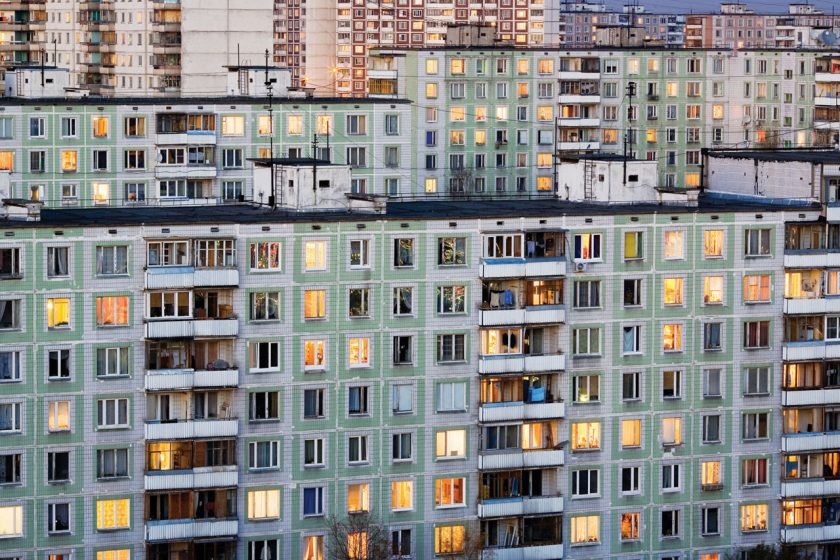
Column: Value (f)or Money
Friday, 27 May 2016During 4 years, between 2008-2011, Erick van Egeraat published his articles in the magazine Commercial Real Estate Russia. This column was published in February 2009.
VALUE (F)OR MONEY
We are now more than two months into the New Year and the initial panic, or let us call it hysteria about the economic meltdown has far from dampened. On the contrary, both in America and England, it seems to have turned into a media controlled collective chastening. There is really no need to actually travel to London, like I foolishly did last month, to experience firsthand how messed up that economy really is. The City does not just make you feel bad; the overwhelming display of omnipresent ignorance actually makes you pity yourself for having to witness it.
Travelling through Europe this past holiday season however, I was probably quite fortunate not to meet too many people boring their days with endless reflections on our economies. Nonetheless it proved to be quite difficult, even for me, not to allow myself to get lost in the thoughts about how to deal with it all: ‘Save or spend?’ ‘Bargain, innovate, validate…’ ‘Family first or Country first?’ Where lies the root of all this? Can we escape from it? One would trust we would learn from the past, but instead we seem to be falling back into our narrow-minded certainties.
I remember my mother as a very kind and cautious person. We used to talk a lot. Or maybe I should say I was the one who talked and it was my mother who listened for even as a young child I was already very talkative. She was always considerate, very tidy and precise; caring, but also often worried. Once in a while she could be outright blunt and cynical. Like that time years ago when I proudly presented her with my new fiancée who was born and raised in the Eastern part of Europe. My mother’s reaction was disappointing and sharp: ‘Are you marrying a communist?’ And even though I knew she liked my bride-to-be, my mother stood firmly in her view: ‘Once Red, always Red’ she replied. Not a thing that I told her about my fiancée’s disposition, age or background could make her change her mind. It made us talk less and my mother grew even more worrisome. To me, my mother’s reaction will always remain indicative of a real quandary.
When people speak from experience, it is generally based on an unfortunate incident or less advantageous episode in their lives. As bad experiences are usually not an incentive to be bold or open-minded, the automatic response is therefore more likely to be caution, suspicion or flat-out distrust. Precisely the reaction which is now generally considered the most damaging answer to today’s unhealthy economic situation. Although it seems unreasonable to expect anyone to be forward-looking at a time like this, we have no choice but to take a step back and gather the strength to oversee the shortcomings of our conventional views.
Five years ago in 2004, I myself lost one of my offices due to large outstanding invoices being left unpaid and the overnight discontinuation of projects. Equally, the present financial tragedy has not left my activities unscathed. These days delayed payments on ongoing projects combined with prolonged hesitation to start new projects are enough to hit hard on a relatively small group of companies like the one I run. It is not even necessary to cancel large projects to make an architects’ firm stumble. I have to admit that I unfortunately lost a lot of money on both occasions, but I am still happy to be able to continue my work. Now you may ask how I can continue. The answer is that besides the overwhelming support I have received these past months from my clients, staff, friends and colleagues, my work is ultimately based on one thing: value! With my team we just work and sometimes even may make mistakes and have to start again, but we always make value, true value! And this is much more than just money!
In today’s global economy, it is all about creating sustainable global economic growth while striving for orderly unwinding of economic imbalances, both globally and locally. In America democrats and republicans continue to debate on end about whether Fannie Mae and Freddy Mac were the instigators or the victims of last year’s housing and mortgage crisis. Analysts speak in detail about the repackaging of loans and the sale of securities. Entire libraries can now be filled with all that has been written on the subject. This discussion has certainly brought interesting perspectives on the governments’ role in providing good housing, especially in a country that is so proud of allowing the free market to do its work. But months have passed now with a lot of talk about money and hardly any word about quality or shall we say lack of control on the value of the houses which were mortgaged. And let’s be fair, Fanny Mae and Freddy Mac did not trip over just a financial problem. They were essentially unable to provide what they were supposed to do: guarantee the value of the mortgaged objects to the American home-owners. Greedy as any other successful business they too bought into bad loans. Despite all the billions of dollars made and spent to stimulate home-ownership, they failed to warrant the value of the products they were expected to promote.
Here in Russia we face a similar dilemma. At the heart of the current debate is the question whether large investment projects (let us say the Sochi Olympics) should be carried out by federal institutions or entirely left to private investors. But please wake up! This is not a matter of either, or, but both. These projects need both parties to cooperate. And what is more; the federal government should regulate and adjust. Not just the financial but also the real estate markets. And not only here, but everywhere! In the early nineties it was not just Russia but the entire world that considered deregulating the best thing to do. Up until the late eighties the entire real estate production in the Netherlands was, like here in Russia, heavily regulated by the state. In those days the performance of each house or apartment I built as a young architect was thoroughly checked against its price. Was this a good thing? Yes it was! Was it fun and exciting? No, not really. Of course it is more interesting to have the freedom to do outrageous things the way we can now, but not at any cost! Of course it is great if one can take the credits and leave it up to the State to take the risk. This is what’s called ‘privatisation of profits and socialization of risk’. And the year 2008 taught us the hard lesson that this just does not work.
No economy stands on its’ own, but they do all need a very specific trait in which to excel. Russia for example, will never be a cheap producer of commodities so therefore needs to specialize. Selling oil and gas at the best possible price, while at the same time becoming market leader in high-value lifestyle products. Why not use the 2014 Olympics to promote state of the art housing which is inexpensive in price, but excellent in performance. Why not take this opportunity to show that you can make good, high-class housing that is also truly sustainable, well-built and low on energy use, discharge of greenhouse gases and waste. Understandably, neither the State nor a private party can achieve this alone. This is something that needs to be done together. It just needs clear and profound examples to get started and why not receive state funding for it?
In the meantime, we regrettably all seem to suffer from the same disease and refuse to do what is essential to regain a healthy economy; create true value for money! I wonder what it will be for Russia. Will my mother’s statement ‘Once Red, always Red’ prevail or will Russia surprise us all and turn ‘Green’? I am quite sure she would not mind being proven wrong once again. We still have five full years until 2014, the year of the Winter Olympics. That is a long time. Long enough to prove that taking care of our environment is profitable in more than one way, especially in Sochi, Russia.
February, 2009

